1September

A Dorm Doesn’t Have to Be Dreary!

My daughter just moved into her new room at the University of Vermont. Armed with lots of colorful things, we set out to transform her small, off-white-walled room into a happy space with color and texture and a little bit of a feeling of home. We put a WalMart rug on the floor, but I’m thinking a floorcloth would be perfect in there. It would be easy to clean, colorful and customizable. How about UVM and the Catamounts’ catpaws leading the way into the room?

Here’s what I came up with:

4' X 6' UVM floorcloth $720 at CanvasworksI could make one of these using the letters from any school (or the kid’s initials) and just about any school logo. Call me for pricing and options. OR you could make one yourself. You’d just need a 4′ X 6′ blank floorcloth and a few colors of paint.

Of course this would be great in any kid’s room. They can spill on it, pile dirty laundry on it or play with the dog on it. No worries. Just sweep it clean and enjoy it’s cheerful colors for years and years.

Here’s how it looks in my daughter’s room:


Are you interested in learning more about floorcloths and how they are made? Come to Canvasworks on October 5th, 2010 for an interesting day filled with demonstrations, studio tours and painting discussions.

Bring your questions or stop in to browse the gallery and farmhouse. There will also be sale floorcloths, prepared blanks and painting supplies available.

Click here to register!

Here is the tentative schedule:

9:00- 10:00 Welcome: Tour the 19th C farmhouse and lots of floorcloths in use.

10:00-11:00 Canvas Prep 101: From Fabric Bolt to Finished Paint

11:00- 12:00 Latest Works: Lisa will talk about her latest projects and those currently in progress. Museum pieces, murals, new designs, etc.

12:00-1:00 Lunch: Join us for a short walk to the Salmond Covered Bridge for a picnic (please bring your own) while enjoying the Fall Foliage colors. Bring a camera and a sketch book if you’re so inclined!

1:00-2:00 Stenciling and Stamping: Try your hand at creating a canvas-on-cork coaster.

2:00-3:00 Leaf Prints: How to use a fresh leaf to create beautiful prints on canvas.

3:00-4:00 Photoshop- A Crash Course: Lisa will demonstrate the use of Photoshop to create and manipulate designs for use on floorcloths.

4:00-5:00 Question and Answer Session and Wrap Up

Click here to register!

Let’s have some fun. Go ahead, it’s summer, time to relax and daydream… Now picture your perfect home, complete with every furnishing and decoration your heart desires.

Where is the floorcloth of your dreams going to go? Is it in the kitchen, so you don’t have to worry about spills, tracked-in mud, or heavy wear? Is it in the front hallway so it’s the first thing your guests see when they come to visit? Is it on your sun porch, reflecting the bright, cheerful colors? Or is it in the grand dining room, blending perfectly with the top-of-the-line furniture, creating a polished look worthy of the best gourmet feast or family gathering?

Now, what does it look like? Is it whimsical and funky? Is it glamorous and dignified? Is it relaxed and “homey”? Is it historical or Early American? Maybe it’s a couple of these mixed together. What would the color scheme look like? How big would it be?

Now, let’s see what we’ve got! Go ahead and fill in the blanks and put your answers as a comment below. I’ll see how many designs I can come up with for you!

1. My dream floorcloth would be in my ____________________________________.

2. My dream floorcloth would be a) funky  b) glamorous  c) relaxed  d) traditional  e) contemporary  f) other_____________________.

3. The colors would be _____________________________________.

4. How big would this beautiful rug be? ___________________.

Yesterday the FedEx truck came and the Carlyle House floorcloth started its journey to Alexandria, Virginia. Before I packed it up I took a photo of it stretched out on my lawn:

It took over 100 hours of studio time to complete this piece. The layout was very difficult. Notice that the pattern is not “broken” on any of the sides- a tricky math problem which I think most of my college math professors would be happy to see I was able to solve! Then, except for the marbling, every line is straight, and every line is freehand painted- no taping AT ALL. The black and the gold colors all had two coats- so that’s two sets of straight lines!

So, with that one behind me, it’s onward and upward to new summer projects- finishing up some Checks with Artichokes, starting on a large dining room floorcloth for a house in New Hampshire, and starting on a commission from Boston’s Museum of Fine Arts for its permanent collection (more about that later…).

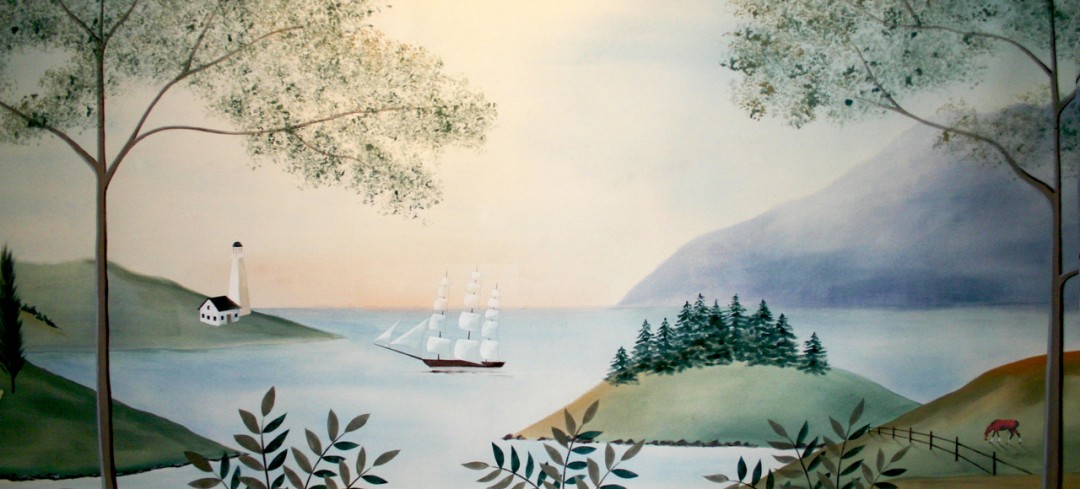
But first, I am painting a mural on canvas for a wonderful house in Vermont:

If you want to hear a little about how I am doing this, there’s a video. Click on the photo below to go there.

Next week I am off to Bridgton, Maine to teach a floorcloth class at the Rufus Porter Museum. Should be a lot of fun! I’m looking forward to meeting a new group of students and getting back into the museum for some mural-inspirations!

11June

Floorcloth Update from Canvasworks

The black polygon shapes on the Carlyle House floorcloth are done. Now we really have three dimensions to look at! This took about 25 hours to paint- two coats, no taping. All that’s left is the border (with a few stripes and a marbled interior), and the finishing coats of Sher Clear and we’re done!

Many of you have been asking about classes. The summer has booked itself up completely for me and the earliest I can schedule anything will be in the Fall. The Weathersfield Inn could handle a group on October 20/21 or October 27/28. If anyone is interested, please let me know and tell me what kind of class you would  most like to attend. In the meantime, don’t forget the Rufus Porter landscape floorcloth class on July 8th and 9th in Bridgton, Maine at the Rufus Porter Museum.

This is the floorcloth students will paint in the one -and -a -half -day class. The added bonus is that the original mural is right downtown, about two blocks from the school and we will go there during lunch break and see what the “real” thing looks like. It’s amazing, and very inspiring! If you’d like to take this class, sign up right away. There are only a couple of spaces left. Click here for more information.

It took a week and now one color of the shading on the Tumbling Blocks floorcloth is complete. Each polygon was painted freehand, using the pencil marks as guides. The floorcloth was rolled up and the first row rolled out. The polygons were painted and then repainted with a second coat before rolling the next section out and proceeding with the next row. Theresa says the repetition is “therapeutic”. Some would say you gotta be crazy to take on this task!

Now we move on to the last set of polygons. These will be black so a huge difference will pop out for my next posting. Stay tuned!

I also just installed another “around the corner” floorcloth this weekend. This one is eleven feet long and wraps around the stairwell. I had measured for this piece myself, but still I get nervous when it comes time to see if it’s going to fit. The added complication with a design such as this is to make the pattern fit so that no elements are awkwardly cut off. It’s all about scale and geometry!

Other details about this design can be seen by clicking here.

It’s always a feeling of accomplishment to get past the preparatory stages of painting a floorcloth and actually START painting the floorcloth! This latest step involved painting the marble texture on the background diamonds. Before the whole pattern was laid out, we painted the entire front in Monterey White (off white). To create the marbled look, I painted a runny concoction of Monterey White mixed with paint conditioner and water over the diamond areas.

Next, using a similarly mixed marble paint in Richmond Gold and a small round brush, I squiggled vein-like marks over the diamond. Dropping wet paint into wet paint causes the marble effect to happen. The paint bleeds out into the other areas. It doesn’t matter if it goes over the lines, all the other areas will be painted again anyway. I try to keep this loose, but also keep the same diagonal direction of marble veins from one end of the floorcloth to the other.

Here’s another shot, showing the diamond (and others around it) finished. Now I let the whole thing dry overnight, and then we can start painting one side of the tumbling blocks.

19May

Finishing Layout of Carlyle House Floorcloth

After ten and a half hours of calculating, measuring, head-scratching, cursing and more measuring, I have finally completed the layout of the Carlyle House floorcloth. The tricky part of this process is that there are no continuous straight lines in this design, so each row of “blocks” is dependent on the one before it. And on a piece such as this being nearly 12 feet wide, if the measuring goes off by as little as a sixteenth of an inch on one side, it can be off by inches on the other. Not a pretty sight! (Scroll down a couple of posts to see the design.)

I use a laser light to produce a line square to the edge of the floorcloth which ensures that the blocks stay true to the pattern. I move the laser light with each successive row (14 rows in all on this design). A card stock template helps to prevent measuring errors. Every angle on this design is either 90 or 45 degrees, so those are easily checked with a plastic square.

Even with all of these tools and careful measuring, mistakes are still made. Unfortunately, it’s hard to detect them until you’ve gone far enough to disturb the pattern. That means erasing an entire row (half an hour of work) before correcting the error and moving forward again.

I don’t know if you can see the lines drawn in this photo. Click on the photo to see a closeup. I do the lines quite lightly so that they are easily erased, if need be, and so they won’t be visible on the final floorcloth. The next step will be marblizing the diamonds. Stay tuned.

There have been several requests for a class covering how to layout this design. It really is a difficult process, and what I’ll do is offer it as an “Advanced” online class. In order to take it, participants will be required to take an Intro “Laying out a Geometric Floorcloth” online class. Look for details about the Intro class later this week.

14May

Second Update on Carlyle House Floorcloth

The next preparatory steps for the Carlyle House Tumbling Blocks floorcloth were completed this week at the studio. First, the back hem was painted. Since the outside edge of the design is black, I painted the hem black as well. To prevent getting paint on the unpainted back of the floorcloth I slid a piece of card stock under the edge of the canvas. This way I  painted right over the cut edge, locking the fabric and preventing fraying, and I still avoided getting paint on the raw canvas. I slid the card along as I painted, going all the way around the perimeter of the floorcloth.

When the hem was done it looked like this:

After the black paint was completely dry, we carefully flipped the whole floorcloth over. Using a 4″ wide brush, Theresa painted the entire pre-primed front side in Monterey White. We do that by rolling the whole floorcloth up and unrolling 2 feet at a time to paint. This means we don’t have to get up on the table. We just paint what is immediately in front of us and unroll as we are ready for a new section. We work quickly, so that one section doesn’t dry before we paint the next section. Overlaps are very visible if drying happens between layers. We always paint the entire surface in one session, so that the finished surface is uniformly coated.

Here it is all painted. It’s a little bumpy in this photo because it’s still a little damp. It flattened completely as it dried.

This weekend I will crunch some numbers and put my geometry skills to work as I prepare to layout the Tumbling Blocks design. Check back here next week for another progress report.

Big news! We are offering a special Memorial Day Floorcloth Kit for the do-it-yourselfers. Click here for details about that. It’s a beautiful flag-inspired design that is easy enough for beginners and the whole kit is only $30!

Please comment below if there is any specific floorcloth information you’d like to have included in upcoming posts. I’m always looking for new topics and it helps me to know what you like to read about!

7May

Carlyle House Floorcloth Project Begins!

Last week I started working on a floorcloth for the study in the historic Carlyle House in Alexandria, VA. The Carlyle House was completed in 1753 by British merchant John Carlyle for his bride, Sarah Fairfax of Belvoir, member of one of the most prestigious families in colonial Virginia. Their home quickly became a center of social and political life in Alexandria and gained a foothold in history when British General Braddock made the mansion his headquarters in 1755. Braddock summoned five colonial governors to meet there to plan the early campaigns of the French and Indian War. On the National Register of Historic Places, Carlyle House is architecturally unique in Alexandria as the only stone, 18th-century Palladian-style house.

There are already several floorcloths in use in the museum, so it is a great place to visit if floorcloths are of interest to you!

The design the curator has chosen is based on the floorcloth shown in a painting from the Abby Aldrich Rockefeller Museum in Williamsburg. It is a tumbling blocks pattern, from John Carwitham’s collection of designs for floors published in 1739. I have painted several floorcloths using this pattern. It’s very tricky to layout, but the final effect is very stunning.

To make it even more complicated, the room is ‘L’ shaped and the overall dimension makes it larger than one piece of canvas, so I’ve had to splice the canvas together. Last week we shrank enough canvas for the two pieces which were to be spliced together. When they were dry, primer was applied and they were cut to two pieces and carefully spliced.

Here are the two shrunk and primed pieces waiting to be spliced. After splicing , I carefully measured the entire floorcloth, allowing for the hem. The next step was to cut all the way around (after measuring one more time, just to be sure). The corners were sewn and turned and the entire hem was pressed flat, then sewn. It was very tricky getting the ‘L’ shape through the sewing machine. We roll all but the side we’re sewing and guide it through the machine. The ‘L’ creates a whole new dimension of sewing problems.

Here it is, all sewn and ready for paint! This is the backside.

I’m planning to try to post photos of my progress on this project. The easiest way for me to do that is on my Facebook page. So if you’re interested, please “like” the Canvasworks page and you’ll get notices whenever I post something about this floorcloth. Go ahead and ask questions too. I’m happy to show you how I create a piece like this.